Marine and Estuarine Ecology
Marine ecosystems, estuaries, ocean chemistry, coral reefs, and open ocean habitats. MIT invitational-relevant content.
📖 Overview
Marine ecosystems, estuaries, ocean chemistry, coral reefs, and open ocean habitats. MIT invitational-relevant content.
📚 Study Guide
An estuary is a semi-enclosed coastal body of water where freshwater from rivers and streams mixes with saltwater from the ocean. This mixing creates one of the most dynamic and productive environments on Earth — a transition zone shaped by tides, river flow, and the constant interplay between fresh and salt water.
Salinity Zones
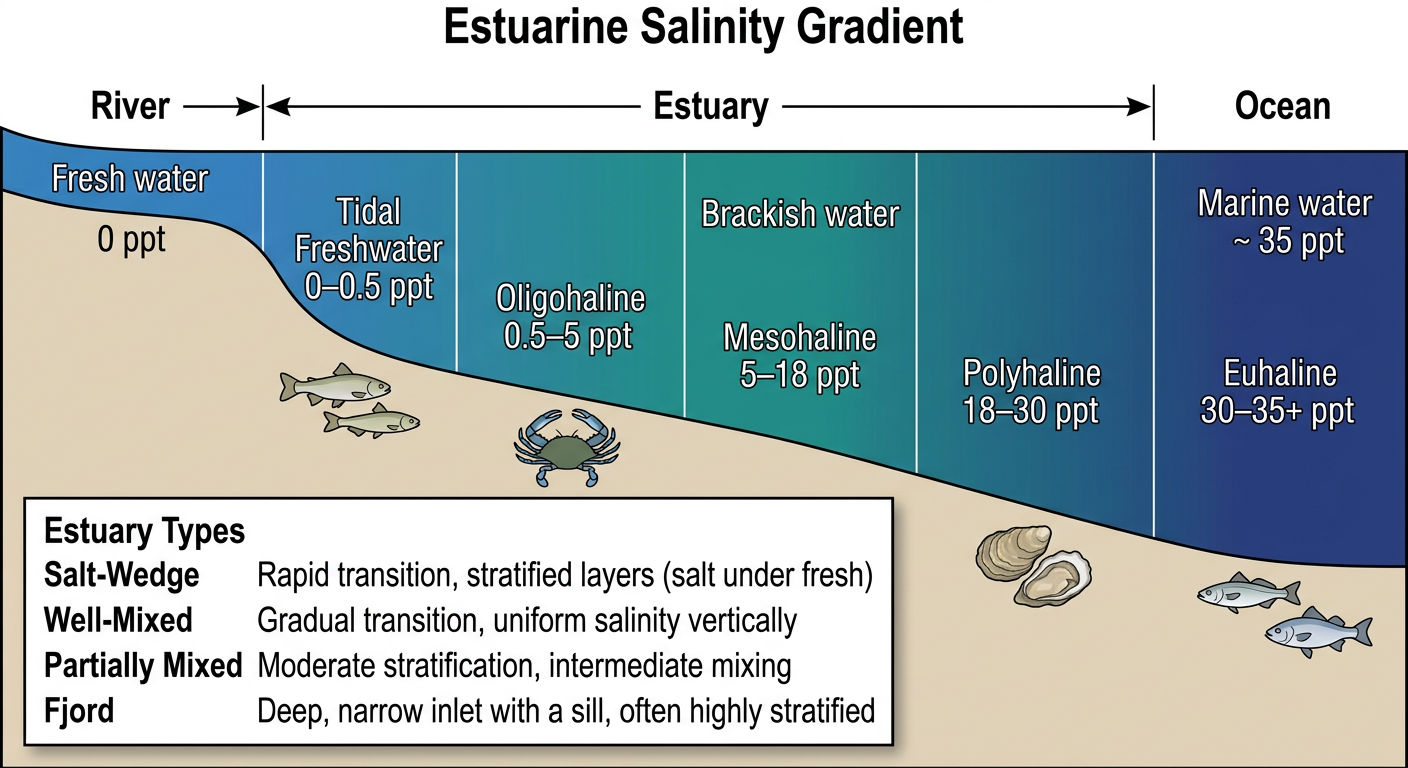
Salinity in estuaries is measured in practical salinity units (psu) or parts per thousand (‰). Moving from the river mouth toward the sea, ecologists recognize four salinity zones. The tidal fresh zone (0–0.5 psu) is dominated by freshwater organisms but still influenced by tidal action. The oligohaline zone (0.5–5 psu) marks the transition where salt begins to stress freshwater species. The mesohaline zone (5–18 psu) is often the heart of the estuary — highly productive and species-rich. Finally, the polyhaline zone (18–30 psu) approaches full marine conditions near the ocean inlet.
Within this salinity gradient, two important physical structures form. A halocline is a sharp vertical boundary between water layers of different salinity — less dense freshwater floats above denser saltwater. In many estuaries, this creates a salt wedge: a tongue of dense, salty ocean water that pushes inland along the bottom beneath lighter freshwater flowing seaward on the surface. Tides alternately push the salt wedge inland and allow freshwater to flush it back — a process that drives nutrient cycling and biological productivity.
Types of Estuaries
Estuaries are classified by how they formed. Coastal plain estuaries, also called drowned river valleys, occur when sea levels rise and flood an existing river valley. The Chesapeake Bay is the classic example — the flooded valley of the Susquehanna River — and this type is the most common along the US East Coast. Bar-built or lagoonal estuaries form when sandbars or barrier islands close off a coastal lagoon from the open ocean. These are common along the Gulf Coast and are typically shallower and
…
Coral reefs cover less than 1% of the ocean floor yet support an estimated 25% of all marine species. Understanding how reefs work — and why they are disappearing — is one of the most urgent topics in marine biology.
Coral Anatomy and the Zooxanthellae Symbiosis
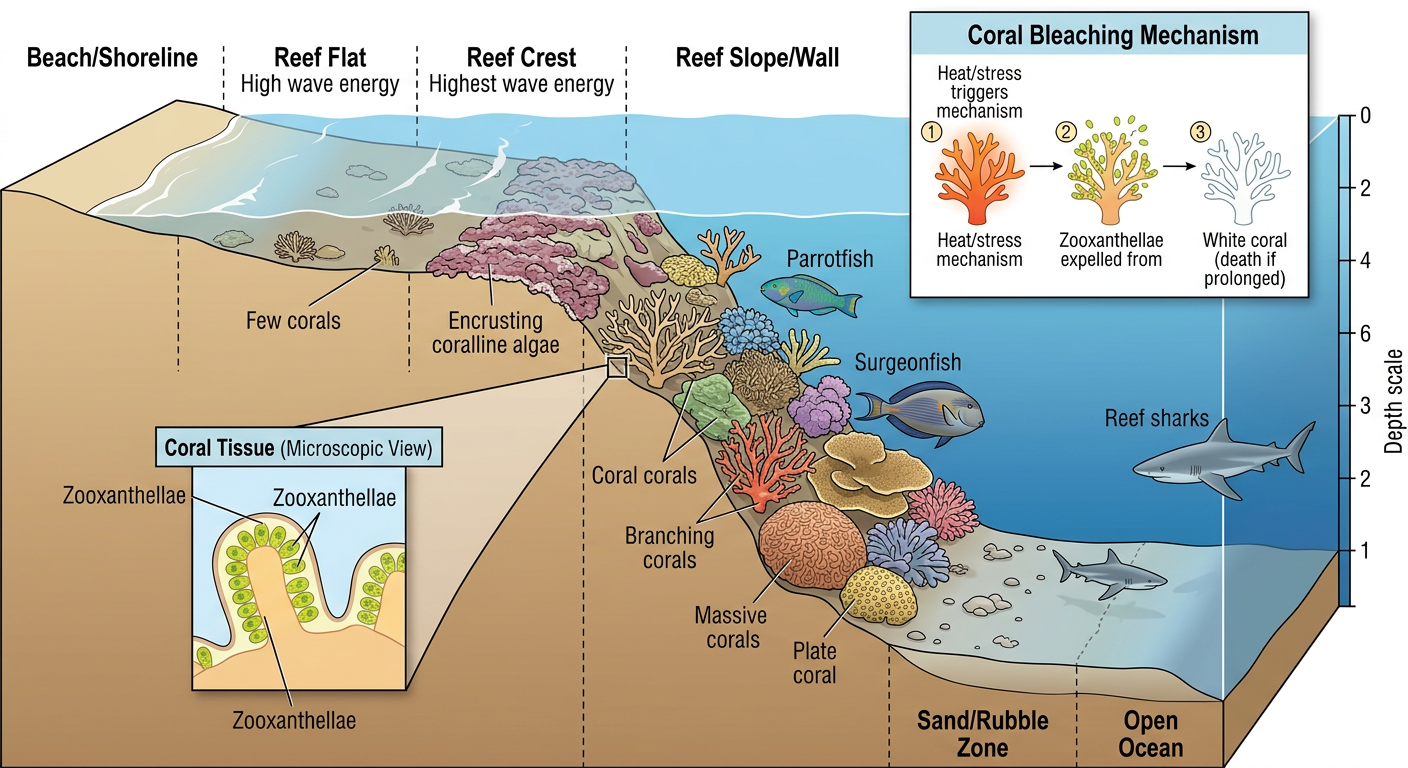
A coral colony is built from thousands of genetically identical polyps — tiny, soft-bodied animals in the phylum Cnidaria. Each polyp secretes a calcium carbonate skeleton, and over centuries these skeletons accumulate to form the reef framework. Corals are animals, but they function almost like plants because of a critical symbiotic relationship with photosynthetic dinoflagellates called zooxanthellae (genus Symbiodinium and relatives), which live inside the coral's tissues. The coral provides the algae with shelter and a steady supply of CO₂ and nutrients; in return, the zooxanthellae photosynthesize and transfer sugars and lipids back to the coral — providing up to 90% of the coral's energy needs. This partnership is why reef-building corals are restricted to shallow, clear, sunlit tropical waters.
Coral Bleaching
When water temperature rises even slightly above normal summer maximums, the zooxanthellae begin producing reactive oxygen species that damage coral tissues. The coral responds by expelling the algae. Without their symbiotic partners, the coral's pale white skeleton shows through its transparent tissue — hence "bleaching." A bleached coral is not dead, but it is starving. If temperatures return to normal within a few weeks, zooxanthellae can recolonize and the coral recovers. Prolonged bleaching — lasting four weeks or more — leads to coral mortality.
The thermal threshold for bleaching is typically 1–2°C above the mean summer maximum temperature for that location. Scientists quantify heat stress using Degree Heating Weeks (DHW): one DHW accumulates for each week that temperatures remain 1°C above the bleaching threshold. Bleaching is likely when DHW reaches 4, and widespread mortal
…
The world's oceans have absorbed approximately 25–30% of all carbon dioxide emitted by human activities since industrialization. This absorption has slowed climate change — but at a cost. The CO₂ dissolving into seawater triggers a cascade of chemical reactions that are measurably changing ocean chemistry, threatening organisms that build shells and skeletons from calcium carbonate.
The Carbonate Buffer System
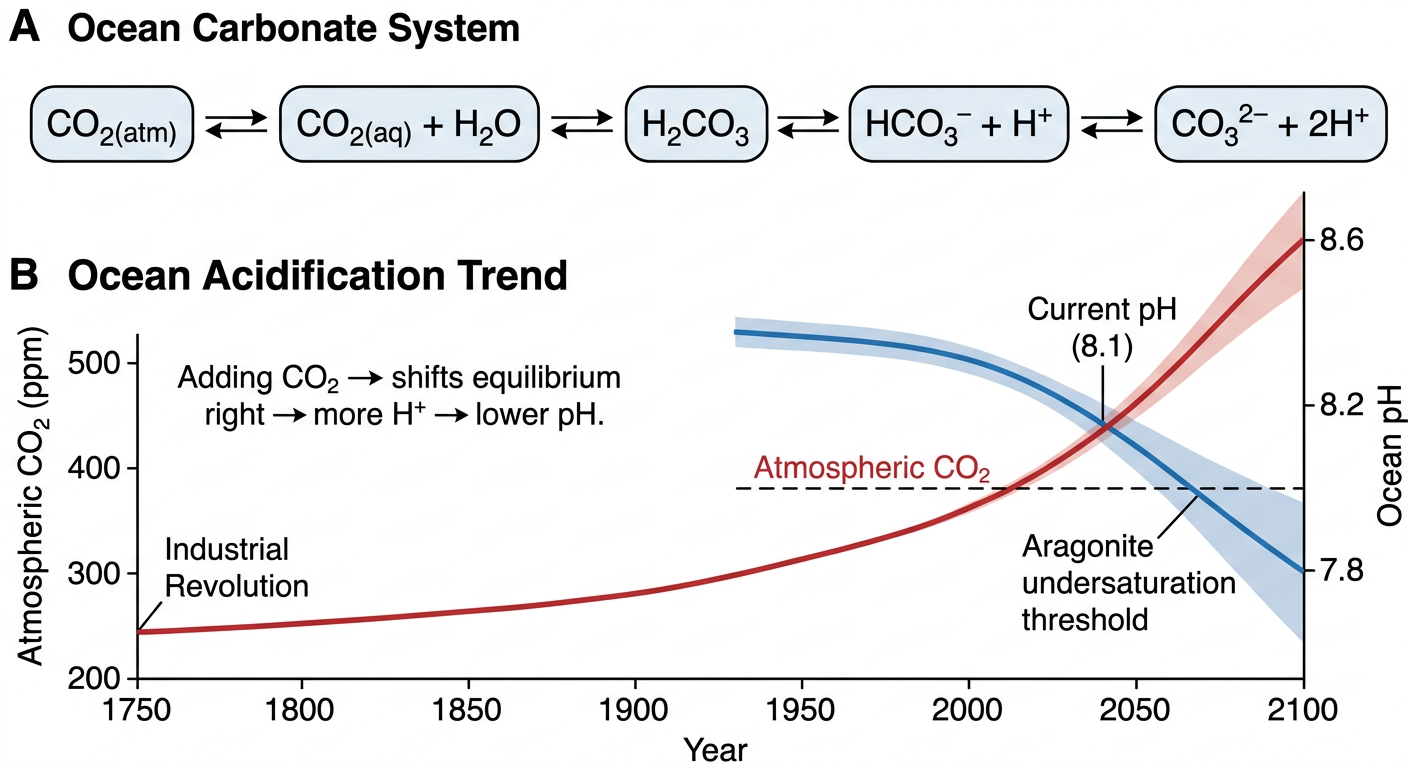
When CO₂ dissolves in seawater, it reacts with water to form carbonic acid (H₂CO₃), which rapidly dissociates. The full equilibrium chain is:
CO₂(aq) + H₂O ↔ H₂CO₃ ↔ H⁺ + HCO₃⁻ ↔ 2H⁺ + CO₃²⁻
Adding more CO₂ pushes the equilibrium to the right, increasing the concentration of hydrogen ions (H⁺) and bicarbonate (HCO₃⁻) while consuming carbonate ions (CO₃²⁻). Higher [H⁺] means lower pH — the defining characteristic of ocean acidification. Critically, it is the carbonate ion CO₃²⁻ that shell-forming organisms use for calcification; as CO₂ rises, carbonate ion concentration drops even as total dissolved inorganic carbon increases.
Observed and Projected pH Change
Since the industrial revolution, mean ocean surface pH has fallen from approximately 8.2 to 8.1 — a drop of 0.1 pH units. Because pH is a logarithmic scale (pH = –log[H⁺]), a decrease of 0.1 units represents a 26% increase in hydrogen ion concentration:
10^0.1 ≈ 1.26, so [H⁺] increases by a factor of ~1.26
For exam practice: if pH drops from 8.1 to 8.0, [H⁺] increases by 10^0.1 = 1.26 (26% more acidic). A drop from 8.2 to 8.0 would be 10^0.2 ≈ 1.58, a 58% increase. Under business-as-usual emissions scenarios, ocean pH could fall to ~7.8 by 2100, representing a roughly 150% increase in [H⁺] relative to pre-industrial levels.
Aragonite Saturation State
The aragonite saturation state (Ω_arag) quantifies whether seawater favors the formation or dissolution of aragonite, the crystalline form of calcium carbonate used by corals and pteropods:
Ω = [Ca²⁺][CO₃²⁻] / K_sp
where K_sp is the sol
…
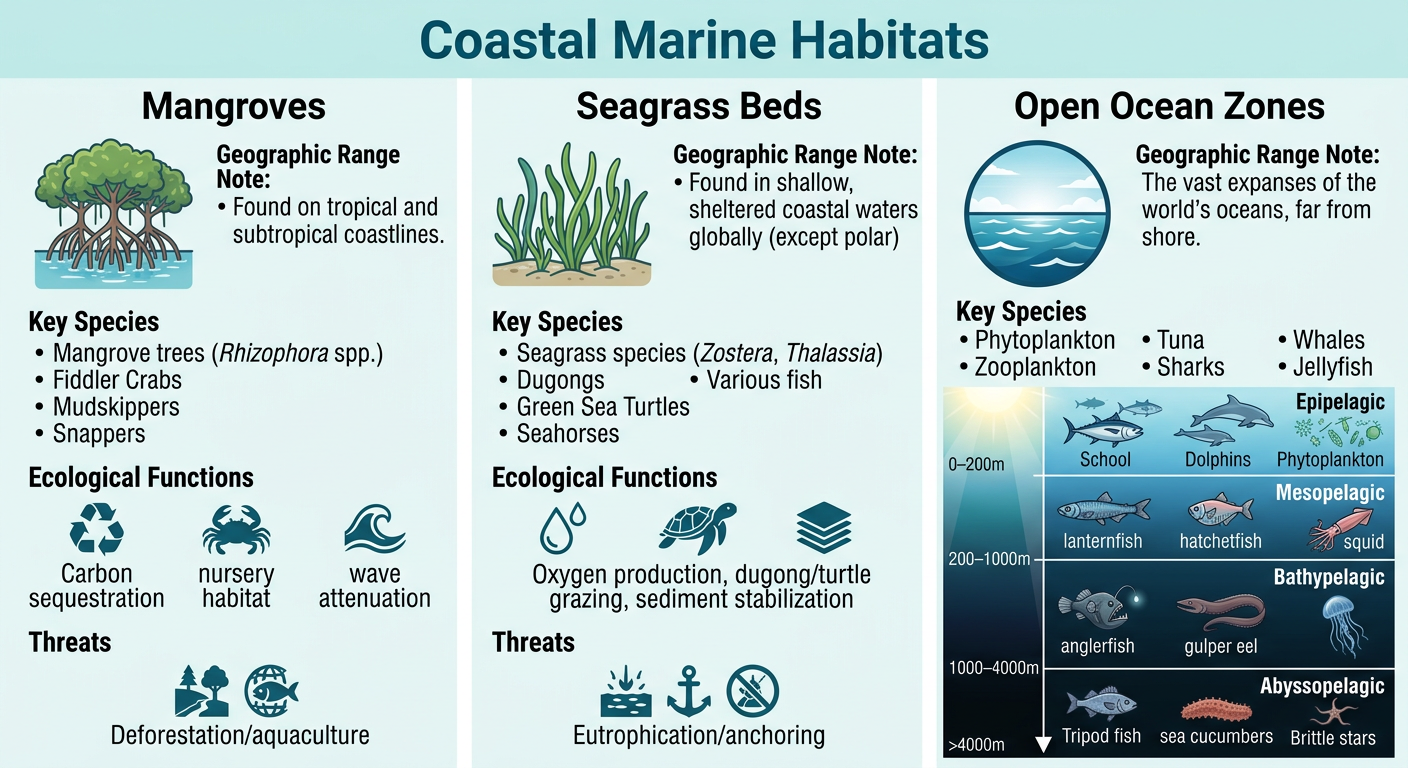
The ocean is not uniform. From coastal wetlands to the open sea, dramatically different habitats support distinct communities shaped by light, nutrients, salinity, and physical disturbance. Understanding the structure and function of these habitats — and the threats they face — is essential for marine conservation.
Mangrove Ecosystems
Mangroves are salt-tolerant trees and shrubs that grow along tropical and subtropical coastlines, typically between the high and low tide marks. They are engineering species: their structural roots physically build and stabilize the coastline. Two key morphological adaptations allow them to survive in waterlogged, oxygen-depleted (anoxic) sediments. Prop roots arc from the trunk into the mud, providing structural support in unstable substrate. Pneumatophores are specialized vertical root extensions that project above the mud surface like snorkels, allowing gas exchange with the atmosphere when sediments are too oxygen-poor for normal root respiration.
Mangroves are also notable for vivipary: their seeds germinate while still attached to the parent tree, producing a seedling (propagule) that drops into the water ready to take root. This adaptation helps propagules quickly establish in soft, unstable sediments.
The ecosystem services provided by mangroves are exceptional. Like estuaries, they serve as nursery habitat for fish, shrimp, and crustaceans. They are exceptional blue carbon sinks — mangrove sediments store 3 to 5 times more carbon per unit area than tropical rainforests, thanks to slow decomposition in waterlogged anaerobic soils. They stabilize shorelines by trapping sediment with their roots and provide wave attenuation: their dense root systems dissipate wave energy, significantly reducing storm surge damage and coastal erosion during hurricanes and tsunamis.
Despite their value, approximately 35% of global mangrove area has been lost since 1980. The primary drivers are conversion to aquaculture ponds (especially sh
…
❓ Practice Questions
No practice questions linked to this module yet.
🎬 Study Videos
No videos linked to this module yet.
🔗 Resources
-
EPA's Rapid Bioassessment Protocols for Use in Streams and Wadeable Rivers — the standard reference for macroinvertebrate sampling, habitat assessment, and biotic index calculation.
-
USGS fact sheet covering mercury sources, methylation in aquatic sediments, bioaccumulation in fish, and biomagnification to top predators. Covers SciOly topics 6.1 (heavy metals), 6.2 (methylmercury), and 6.3 (biomagnification) in an authoritative, accessible format.
-
USGS fact sheet covering mercury sources, methylation in aquatic sediments, bioaccumulation in fish, and biomagnification to top predators. Covers SciOly topics 6.1 (heavy metals), 6.2 (methylmercury), and 6.3 (biomagnification) in an authoritative, accessible format.
-
Step-by-step salinometer build guide covering conductivity measurement, electrode design, and temperature correction (~2%/°C).
-
Detailed build log for a Science Olympiad digital salinometer (2012). Covers opamp circuit, Wien bridge oscillator, Peltier temperature controller, digital voltmeter, and conductivity measurement principles.
-
Competition strategy page covering ecosystem effect chains, turbidity impacts, eutrophication chains, and WQI parameter reasoning. Excellent for multi-concept questions.