Rubber Motor Physics
Helicopter competition and construction topics for Module 5
📖 Overview
Helicopter competition and construction topics for Module 5
📚 Study Guide
5.1 Elastic Potential Energy Storage
The Energy Bank of Your Helicopter
Every second your helicopter stays aloft, it is spending energy. The only "bank account" it has is the twisted rubber motor wound before launch. Understanding how energy is stored in that motor — and how to maximize it — is foundational to competing at the highest level in Science Olympiad Helicopter.
Core Concept: Elastic Potential Energy in Twisted Rubber
When you wind a rubber strip, you are doing mechanical work against the internal elastic forces of the material. That work is stored as elastic potential energy (EPE) within the molecular structure of the rubber. Unlike a stretched spring, which stores energy through linear deformation, a twisted rubber motor stores energy through torsional (rotational) deformation. The polymer chains in vulcanized rubber resist twisting, and as you add turns, those chains become increasingly strained — storing progressively more energy per additional turn, up to a limit.
At low wind counts, the rubber behaves roughly like a linear torsional spring, and energy scales with the square of the twist angle. At high wind counts approaching the motor's limit, the rubber begins to form tight coils (a process called "supercoiling" or "plying"), and the energy storage becomes highly nonlinear. This transition region, just before breakage, actually represents the maximum energy state and is where experienced builders aim to wind.
Key Formulas
For a rubber motor behaving as an ideal torsional spring (low-to-moderate wind counts), the stored elastic potential energy can be approximated as:
E = ½ · k · θ²
Where:
- E = elastic potential energy (Joules)
- k = torsional stiffness constant of the motor (N·m/rad), which depends on the rubber's shear modulus, cross-sectional geometry, and length
- θ = total twist angle (radians) = 2π × N, where N is the number of turns
The torsional stiffness constant k for a rectangular rubber cross-sect
…5.2 Rubber Width & Torque Matching
Core Concept: Width, Torque, and the Energy Trade-Off
The rubber motor in a Science Olympiad helicopter is not simply an energy reservoir — it is a torque-delivery system. Understanding how rubber width governs the shape of that delivery is fundamental to building a competitive aircraft.
Torque, in this context, is the rotational force the motor applies to the rotor shaft. It arises from the elastic stress stored in the twisted rubber strands. When you wind a rubber motor, you are introducing torsional strain energy into the material. The motor then releases this energy as it unwinds, driving the rotor. The critical insight is that rubber width directly controls both the peak torque available and the total number of winds the motor can sustain.
Wider rubber — achieved either by using a wider flat strip or by bundling more strands — presents a larger cross-sectional area to torsional stress. Because torque scales with the material's resistance to twisting, a wider motor produces substantially higher peak torque at low wind counts. However, the same wider cross-section reaches its elastic limit (and ultimately its breaking point) at far fewer total turns. The motor is powerful but short-lived in its turn count.
Narrower rubber behaves in the opposite manner. The smaller cross-section means lower peak torque per wind, but the material can absorb many more turns before approaching its elastic or mechanical limit. Narrow motors spin longer and with a more gradual torque decline, but they may never generate enough peak force to keep the rotor aloft through the high-torque demand of initial climb.
This trade-off defines a central optimization problem: match the rubber width to the rotor's torque requirement so that the motor neither stalls the rotor (too little torque) nor over-drives it (excessive torque causing blade stall or structural failure), while maximizing total flight duration.
Key Formulas
The energy stor
…5.3 Rubber Length & Loop Size
Core Concept: Length as a Tuning Variable
The rubber motor in a free-flight helicopter is not simply an energy source — it is a precisely tunable mechanical system whose geometry controls how energy is released over time. Motor length is the single most influential geometric variable in that system.
Each wind introduces torsional strain into the rubber strand. For a short motor, the same number of turns compresses that strain into less material, so stress rises steeply. A longer motor distributes the same turns over more material, and stress rises more gradually. In practical terms: a longer motor accepts more turns before kinking, stores more total elastic energy, and delivers a flatter, more extended torque curve during unwinding.
A short motor produces a sharp torque spike early in flight and exhausts quickly. A long motor winds to a higher turn count, sustains moderate torque for longer, and transitions more smoothly into the glide phase. For a competitive helicopter where flight duration is the metric, the long-motor approach almost always wins — provided the rotor is designed for the torque levels that motor delivers.
Key Formulas
The elastic potential energy stored in a wound motor is approximated by treating it as a torsional spring:
U = ½ · k_eff · θ²
where:
- U = stored elastic potential energy (J)
- k_eff = effective torsional stiffness of the motor (N·m/rad)
- θ = total wind angle in radians (θ = 2π × number of turns)
The effective stiffness scales inversely with motor length:
k_eff = G · J / L
where:
- G = shear modulus of the rubber (Pa) — a material constant
- J = polar second moment of area of the cross-section (m⁴), proportional to strand area
- L = motor loop length (m)
Doubling motor length halves stiffness, halving torque per unit twist. To store the same energy at half the stiffness, the motor must wind to √2 times as many turns — it accepts more winds at moderate torque an
…Lubrication is one of the most accessible and highest-return-on-investment techniques in rubber motor optimization. A properly lubricated motor can accept 10–20% more winds than a dry one, stores more elastic potential energy, and survives far more flight cycles before breaking. Understanding why requires a brief excursion into tribology — the science of friction, wear, and lubrication between interacting surfaces.
The Tribology of Rubber Under Torsion
When a rubber motor is wound, adjacent molecular strands within the elastomer are forced into tight contact as the motor twists on itself. Natural rubber (polyisoprene) and its synthetic counterparts are viscoelastic materials: they behave simultaneously like viscous fluids and elastic solids. Under torsion, the polymer chains experience both elastic strain (stored as potential energy) and internal friction as chain segments slide past one another. This internal friction manifests as heat — a wound motor feels noticeably warm — and represents energy lost to the system rather than converted into propeller work.
The situation worsens at the motor's outer surface. As winding progresses, the motor coils over itself, and the external rubber-on-rubber contact introduces additional interfacial friction. At these contact zones, microscopic surface asperities (tiny peaks and valleys on the rubber surface) interlock and resist relative motion. The cumulative effect raises the torque required to add each successive wind, shortens the elastic limit, and concentrates stress at coil overlap points — the exact sites where motors most commonly snap.
A lubricant placed between these surfaces reduces asperity interlocking, lowers the coefficient of friction, and allows the polymer chains to slide more freely. The result is a motor that winds to a higher turn count before reaching mechanical failure, releases energy more smoothly during unwinding, and undergoes less fatigue damage per flight cycle.
Silicone vs. Petroleum-Base
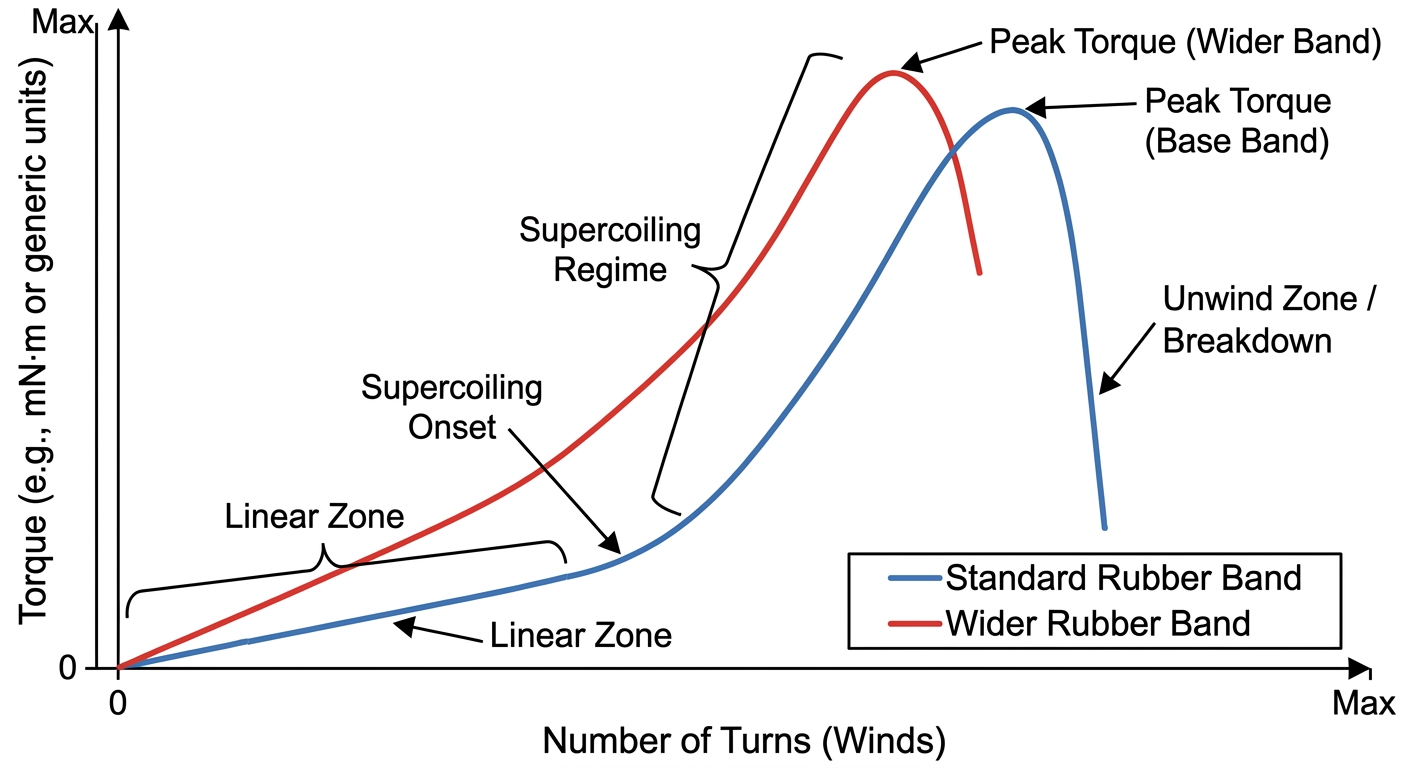
…The torque-vs-turns curve is the single most important diagnostic tool in rubber-powered flight. It encodes everything about how a rubber motor stores and releases energy across its winding cycle — and understanding its shape at a mathematical level separates teams that optimize systematically from those that tune by feel.
The Shape of the Curve and Why It's Non-Linear
If rubber behaved as a simple linear torsional spring, torque would rise proportionally with turns: τ = k·θ, where k is a constant stiffness and θ is the total angular displacement. Real rubber does nothing of the sort. The actual torque-vs-turns curve has three distinct regimes.
In the linear regime (roughly 0–40% of maximum winds), the rubber strands twist without significantly changing their cross-sectional geometry. Torque rises modestly and nearly linearly here, and the motor feels "soft." Energy storage is relatively low per turn.
At the supercoiling onset, the strands begin to pleat and buckle into tight helical supercoils — a geometric phase transition. The cross-sectional moment of inertia of each strand drops sharply as strands bunch together, but the internal stress per unit volume rises steeply. The net effect is that torque climbs rapidly and nonlinearly. This is where the bulk of the motor's energy is stored. The onset turn count depends on motor length, strand count, and lubrication, but typically begins around 50–65% of maximum winds.
Near peak torque, supercoiling has propagated through most of the motor length. The torque reaches a maximum τ_max before the motor is physically wound to its limit. Beyond this point, continued winding compresses already-supercoiled bundles against each other, and torque actually decreases as the structure approaches a mechanical end stop. Overstressing the motor in this regime risks breakage.
Key Formulas
A useful engineering model treats the rubber motor as a nonlinear torsional spring with a strain-energy function. For a single st
…
5.6 Stretch-Winding Technique
Core Concept: Why Stretching Stores More Energy
Rubber motors used in Science Olympiad Helicopter events are elastic systems governed by nonlinear elasticity — meaning the energy stored per unit of deformation increases dramatically as the rubber is stretched and twisted simultaneously. Stretch-winding, sometimes called backwinding, exploits this nonlinearity to pack significantly more turns into a motor of fixed length, increasing energy storage by roughly 30–50% compared to straight winding under identical turn counts.
The key insight is that rubber, unlike a linear spring, does not store energy proportionally to strain. Instead, it follows a complex hyperelastic stress-strain relationship. When you stretch the motor to 4–5× its relaxed length before and during winding, you are operating the polymer chains in a regime where they are already under substantial tensile pre-stress. Adding torsional strain on top of this pre-stress requires more work per turn — and that extra work is stored as potential energy in the motor. When released, that energy becomes the rotational torque driving your rotor.
Key Physics: Pre-Tension and Supercoiling
To understand why stretch-winding is so effective, consider what happens at the molecular level. Natural rubber (polyisoprene) consists of long, randomly coiled polymer chains. In the relaxed state, these chains are kinetically free to adopt many conformations. Stretching the motor extends and aligns the polymer chains along the motor's longitudinal axis, dramatically reducing their conformational entropy. This entropic tension — a restoring force arising from the thermodynamic drive to return to maximum disorder — is the same mechanism responsible for rubber's elastic recoil.
When you wind a pre-stretched motor, you are imposing torsional strain on top of this existing axial tension. The result is a coupled deformation state. As turns accumulate, the rubber strands begin to form superc
…5.7 Winder Gear Ratios
In competitive rubber-powered helicopter flight, the margin between a record-breaking run and a snapped motor is often just a few dozen turns. That precision demands a tool that can translate coarse hand-crank motion into fine, countable rotations of the rubber motor — and that tool is the mechanical winder. At the heart of every winder is a gear ratio, a deceptively simple number that governs everything from how long it takes to wind a motor to how accurately you can approach the break limit.
The Core Concept: Mechanical Advantage in Winding
A gear ratio describes the relationship between the rotational input of the driving gear (the crank) and the rotational output delivered to the driven gear (the motor hook). Formally, the gear ratio GR is defined as:
GR = N_driver / N_driven
where N_driver is the number of teeth on the input gear and N_driven is the number of teeth on the output gear. A winder with a 10:1 ratio has a driver gear ten times larger than the output gear, so one full turn of the crank produces ten full turns of the motor hook. A 15:1 winder produces fifteen motor turns per crank revolution.
This multiplication is mechanical advantage applied to rotation. In linear systems, mechanical advantage lets a small force move a large load. In rotational winding, the same principle lets a slow, controlled crank motion produce many motor turns with reduced risk of overshoot. The tradeoff — as always in mechanics — is speed: higher gear ratios take more crank turns to reach a given wind count, but reward you with finer resolution per crank revolution.
Key Formulas
Motor turns from crank turns:
T_motor = T_crank × GR
If you turn a 10:1 winder 40 times, the motor receives 400 turns. With a 15:1 winder, those same 40 crank turns deliver 600 motor turns. This is the formula you'll use most often in the field.
Crank turns required for a target motor count:
T_crank = T_motor / GR
If your flight log sh
…5.8 Over-Winding & Motor Failure
The Physics of Rubber at Its Limit
Every rubber motor has a finite capacity for stored energy — a physical ceiling beyond which the material no longer behaves elastically but instead fails catastrophically. Understanding why and how rubber motors break is not merely academic; in competition, a snapped motor means a grounded helicopter and almost certainly a zero score.
Natural rubber is a polymer composed of long, coiled hydrocarbon chains (cis-1,4-polyisoprene). When you wind a rubber strip, you are imposing torsional strain on these chains, forcing them to rotate and pack together. In the early stages of winding, the chains uncoil and align — a process called strain-induced crystallization — which actually increases tensile strength temporarily. This is why a rubber motor feels progressively stiffer as you approach maximum turns: the material is partially crystallizing and storing significant elastic potential energy.
Beyond a critical strain threshold, however, the polymer chains can no longer accommodate additional twist without structural damage. Micro-tears propagate across the cross-section, and the cumulative damage leads to sudden brittle fracture. The failure is not a gentle unraveling — it is an explosive release of stored energy. On a helicopter, this snap can damage the prop shaft, distort the nose plug, or send rubber debris into the airframe. In competition, there is no recovery.
The maximum number of turns a motor can safely hold is governed primarily by three geometric factors: strand length, cross-sectional area (width × thickness), and the number of strands (single-strand loop vs. multi-strand bundle). Longer motors distribute torsional strain over more material and thus tolerate more absolute turns. Thicker or wider strands have greater cross-sectional area and can store more energy at a given turn count — but they also reach their strain limit at fewer turns per unit length. The key relationship is: *
…❓ Practice Questions
No practice questions linked to this module yet.
🎬 Study Videos
🔗 Resources
-
Two-page NFFS PDF giving a structured overview of helicopter anatomy, construction sequence, and what students and coaches need to know when starting the event.
-
Simplified step-by-step guide to rubber motor selection, winding procedure, and helicopter testing; covers the operational skills needed for Module 7 flight operations.
-
Template and explanation for recording flight data; covers what to log, how to analyze results, and how the flight log contributes to competition scoring (bonus points for a completed flight log).
-
Full kit building instructions for the 2026 Freedom Flight Science Olympiad helicopter; covers balsa selection, carbon fiber application, mylar covering, and assembly sequence in detail.
-
NASA technical paper analyzing airfoil performance at low Reynolds numbers — highly relevant since model helicopters operate at Re much lower than full-scale aircraft; supports advanced physics test component.
-
Official SOINC event page with rules, scoring criteria, links to construction and winding videos, and official resources. The authoritative source for current-year rule clarifications.