Construction Materials & Techniques
Helicopter competition and construction topics for Module 6
📖 Overview
Helicopter competition and construction topics for Module 6
📚 Study Guide
Balsa wood (Ochroma pyramidale) is the foundational material of competitive rubber-band helicopter construction. No other readily available natural material combines its extraordinary lightness with sufficient structural integrity for flight — and understanding exactly why requires a look at its cellular biology, density variation, and mechanical behavior under load.
Core Concept: What Makes Balsa Unique
Balsa is a fast-growing tropical hardwood native to Ecuador and Central America. Despite being classified as a hardwood by botanical definition, it is the lightest commercially available wood in the world. The secret lies in its cellular architecture: balsa cells have extremely thin walls relative to their large internal volumes. This high void fraction — often exceeding 90% — means the wood is mostly air by volume. Those air-filled cells make it spectacularly light, but also give it an isotropic weakness profile that builders must respect.
Grain structure matters enormously. Balsa has three principal axes: longitudinal (along the grain, parallel to tree growth), radial (across the rings, from pith to bark), and tangential (perpendicular to the radius, following ring curvature). Longitudinal stiffness and strength are dramatically higher than the other two — typically 10–20× greater — which means grain orientation in a helicopter part is not a stylistic choice but a structural one. A spar cut with grain running the length of the member is vastly stronger than the same spar cut cross-grain.
Key Metrics
Density range: Commercially graded balsa spans roughly 2 to 20 lb/ft³ (approximately 32 to 320 kg/m³). "Contest grade" balsa sold for model building is typically labeled by density — light (4–6 lb/ft³), medium (6–10 lb/ft³), and heavy (10–14 lb/ft³). Ultralight sheets can approach 2–3 lb/ft³ but are structurally marginal. The density variation is not a manufacturing defect — it reflects genuine differences in growth rate, harvest season, and position wit
…One of the most consequential decisions a helicopter builder makes happens before a single piece is cut: choosing the right balsa for each structural role. Beginners often treat balsa as a uniform material — wood is wood — and select whatever sheet or strip is nearest at hand. Experienced builders know better. Balsa's density, grain orientation, and surface character vary enormously even within the same pack, and matching those properties to each part's mechanical demands is what separates a fragile prototype from a flight-ready competitor.
Core Concept: Structural Requirements Differ by Part
Balsa (Ochroma pyramidale) is one of the lightest hardwoods on Earth, with commercial sheet densities ranging from roughly 4 lb/ft³ (very light, almost foam-like) up to 20 lb/ft³ (dense and almost woody). Within that spectrum, three grain orientations matter: A-grain (tangential cut, flexible and bending-resistant), B-grain (intermediate, general-purpose), and C-grain (radial cut, stiff and hard-faced). The helicopter imposes very different load cases on each subsystem — axial compression, bending, torsion, point-load impact — and no single density or grain is optimal for all of them. The builder's job is to treat balsa selection as an engineering decision rather than a materials-handling chore.
Part-by-Part Selection Guide
Motor stick. The motor stick is the structural spine of the helicopter. It bears the full pre-wound torque of the rubber motor throughout the winding process, absorbs the shock of an abrupt motor release, and resists bending as the prop pulls the nose. Use a medium-density strip, approximately 8–10 lb/ft³, with C-grain orientation. The radial cut gives the stick stiffness in the critical bending plane and resists crushing under the motor's lateral pressure. A strip that feels slightly springy when flexed — firm resistance before significant deflection — is ideal. Going too light here produces a stick that bows during winding and ruins motor geo
…Cyanoacrylate (CA) adhesive is the dominant bonding agent in competitive helicopter construction, and understanding the chemistry behind it explains why no other common adhesive comes close for this application. CA glue is a monomer — ethyl cyanoacrylate is the most common formulation — that polymerizes rapidly in the presence of a weak base. Trace moisture on virtually any surface, including the ambient humidity adsorbed onto balsa wood fibers, is sufficient to initiate an anionic chain-reaction polymerization. Within seconds, the monomer chains cross-link into a rigid, high-strength poly(cyanoacrylate) network. The resulting bond exhibits tensile strengths in the range of 2,000–4,000 psi depending on formulation and substrate, far exceeding the tensile strength of the balsa wood itself. In practice, the wood fails before the glue joint does — which is exactly what you want. Critically, polymerized CA adds negligible mass: a proper joint uses a micro-drop, and the cured polymer contributes less than 0.01 g at most joints. For a helicopter where every tenth of a gram matters, this mass efficiency is decisive.
Comparing CA to its two most common competitors — PVA (white/yellow wood glue) and epoxy — clarifies its advantages and its limits. PVA is water-based, which means it must dry rather than cure; water must physically migrate out of the joint, a process that takes 30–60 minutes under ideal conditions and hours in humid environments. More damaging for precision work, PVA causes wood fibers to swell as water is absorbed, introducing dimensional changes that can misalign blade angles by fractions of a degree — enough to degrade rotor performance measurably. PVA also remains slightly viscoelastic when cured, adding creep under sustained aerodynamic loading. Epoxy offers excellent structural properties and gap-filling ability, but its two-component mixing requirement, 5–60 minute working time, and density (approximately 1.1–1.3 g/cm³ cured) make it poorly suited to u
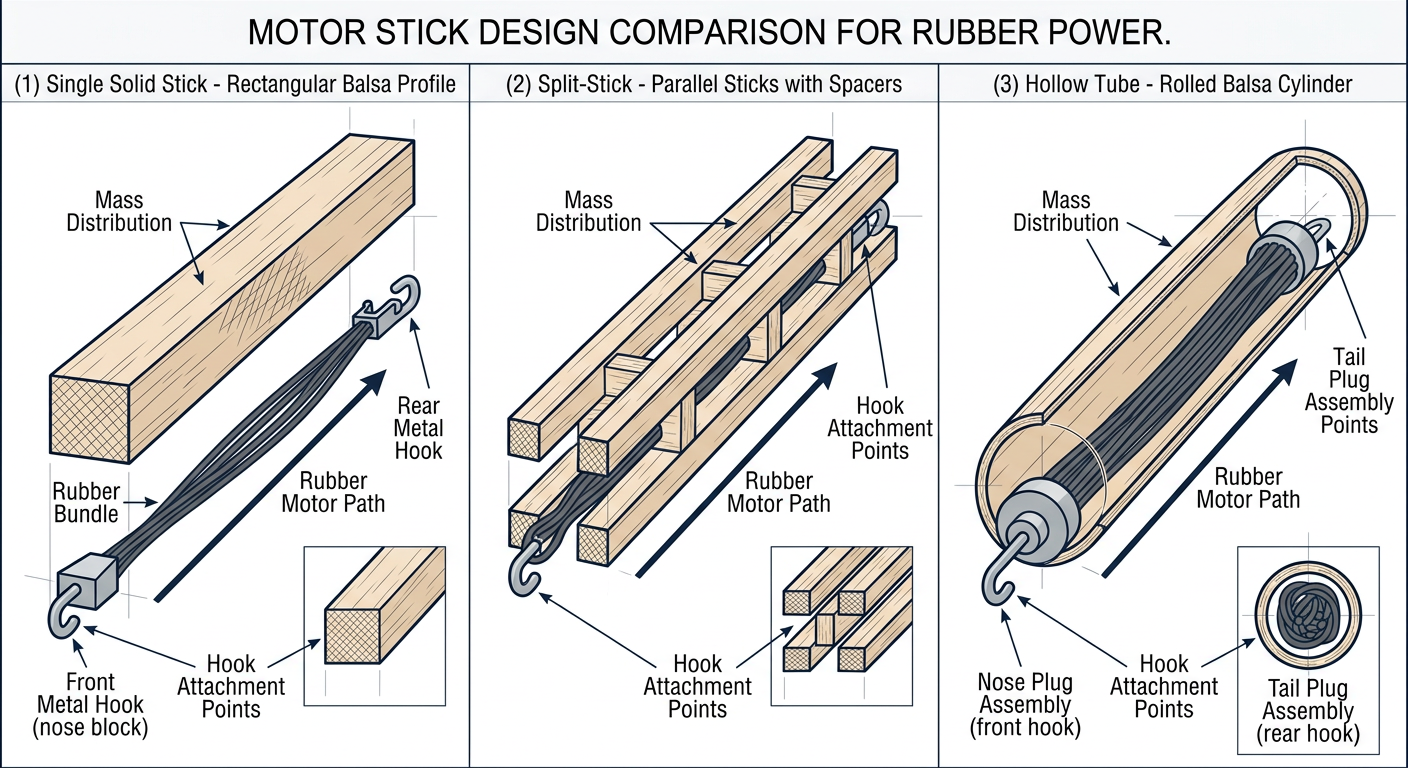
…The motor stick — sometimes called the fuselage or body stick — is the structural spine of a rubber-powered helicopter. It performs three simultaneous roles: it transmits torque reaction forces between the front and rear rotor assemblies, it constrains the rubber motor along a defined axis, and it positions the two hooks (or bearing blocks) that anchor the motor's ends. Because the motor stick occupies the geometric center of the aircraft and directly influences where mass is distributed along the longitudinal axis, its architecture is one of the single most consequential design decisions a builder makes.
Understanding why balance matters so much in a free-flight helicopter starts with the physics of the rubber motor itself. A wound motor is a torsional spring — as it unwinds, it exerts both a rotational force and a longitudinal contraction force. The stick must resist that contraction without bending, and it must keep both rotors co-axial so the counter-rotating lift vectors cancel each other's torques cleanly. Any lateral or torsional flex in the motor stick will cause the rotor planes to cant, producing asymmetric lift and a spiral climb or descent. In competition, a helicopter that corkscrews instead of climbing vertically wastes altitude and flight time. Structural rigidity, low mass, and precise lateral symmetry are therefore the three non-negotiable properties of any motor stick design.
Single-Stick Design
The single-stick is cut from a rectangular balsa strip — typically 1/8" × 1/8" to 3/16" × 3/16" — and is the archetypal beginner's choice. Construction is simple: mount front and rear hooks directly into the end grain, sand to remove twist, and fly. Its primary virtue is speed of fabrication and ease of repair; a cracked stick can be spliced in minutes with cyanoacrylate (CA) glue or simply replaced from stock. The chief liability is asymmetric mass distribution. Because the rubber motor rests along one face of the stick, the center of mass sits off
…
In rotor-powered flight, symmetry is not merely aesthetic — it is a structural and aerodynamic requirement. For Science Olympiad Helicopter competitors, achieving consistent, repeatable blade geometry across every rotor is the difference between a stable, efficient climb and a wobbling, energy-wasting disaster. Building jigs and templates are the systematic answer to this precision problem. They transform what would otherwise be a hand-crafted approximation into an engineered process, and for teams that build multiple rotors over a season, they are indispensable.
Why Geometric Precision Matters
A rubber-band-powered helicopter relies on counter-rotating rotors to cancel reactive torque — the upper rotor spins one direction, the lower spins the other, and if everything is balanced, the fuselage stays still while the aircraft climbs. This balance depends critically on both rotors producing equal and opposing aerodynamic forces. Lift is a function of blade area, pitch angle, airspeed (tip speed), and chord profile. If one blade on the upper rotor has a pitch of 18° while its partner has 21°, the rotor disk generates asymmetric lift and introduces a rolling moment. If the upper and lower rotor assemblies have different overall pitch, one overpowers the other and torque cancellation fails — the fuselage spins, energy is wasted, and flight time collapses.
Beyond aerodynamics, physical imbalance creates vibration. Even a 0.05 g mass difference between opposing blades at a 20 cm radius produces a centripetal imbalance force at operating RPM. Over a 30-second flight, this vibration dissipates energy through the airframe and stresses adhesive joints. Precision construction eliminates both problems at the source.
Types of Jigs and Templates
Blade Pitch Jig: The most critical tool in rotor construction. A pitch jig holds a blade spar at a fixed dihedral angle relative to the hub centerline while the glue cures, ensuring that every blade in a set is set to exactly
…In rubber-band-powered helicopter construction, wire components — rotor shafts and motor hooks — appear deceptively simple. They are thin, lightweight, and often fashioned from ordinary paper clips or music wire. Yet these small bends are among the most mechanically consequential decisions a builder makes. A shaft running even a fraction of a millimeter off-axis introduces rotational imbalance that manifests as vibration, and vibration bleeds kinetic energy from the system with every revolution. Understanding the mechanics of wire bending and developing a repeatable shaping technique is therefore a foundational skill for competitive helicopter design.
Core Concept: Wire Bending Mechanics and Why Precision Matters
When you bend wire, you plastically deform the metal beyond its elastic limit. Below that limit, the wire springs back — and this springback must be accounted for in every bend. The amount of springback depends on the wire's material, diameter, and bend radius. Music wire (piano wire) is high-carbon steel with significant springback; you must overbend slightly to achieve the target angle. Paper clips are softer and springback less, but they deform unevenly if the original coiling left internal stresses.
In a helicopter rotor system, the shaft is the axis of rotation for the free rotor. Any deviation from true straightness creates an eccentric mass distribution. By Newton's second law applied to rotation, an eccentric mass generates an oscillating centripetal force — vibration. Even a 0.5 mm lateral offset at the tip of a 60 mm shaft can produce measurable wobble at operating RPM, introducing drag and reducing effective lift. Precision is not perfectionism; it is engineering necessity.
Key Techniques: Bending Consistent Hooks and Shafts
The most important rule in wire bending is to use a hard, defined pivot point for every bend. Finger pressure alone produces inconsistent curves. Instead, use needle-nose pliers with smooth jaws (file away any se
…In rubber-powered free flight, mass is not merely a design consideration — it is the single most direct constraint on performance. Every gram of structural weight that does not contribute to lift, stability, or energy storage is a gram that forces the rubber motor to do more work per unit time, draining the finite stored energy faster and cutting flight time. For Science Olympiad Helicopter competitors, internalizing this relationship and managing it deliberately throughout the build process is the difference between a competitive aircraft and a mediocre one.
The Mass Budget Framework
A mass budget is an engineering accounting tool borrowed from aerospace design. Before any balsa is cut, the builder assigns target masses to each sub-assembly: rotor hub, rotor blades (upper and lower sets), fuselage/body stick, bearing mounts, nose button, tail assembly, landing gear, and rubber motor. These targets must sum to the total flying weight goal — typically the lowest mass at which the aircraft remains structurally sound and dynamically stable.
The connection between mass and flight time follows directly from energy conservation. A rubber motor of fixed length and cross-section stores a roughly constant amount of elastic potential energy when wound to a given turn count. That energy is discharged as mechanical work against aerodynamic drag and gravity. If total aircraft mass increases, induced power requirements rise (roughly proportional to mass^(3/2) in hover-like conditions), meaning the motor depletes faster. A 10% increase in total mass may translate to a 15–20% reduction in flight time — a non-linear penalty that makes even small mass savings worthwhile.
Key Weight Reduction Methods
Systematic Weighing. The foundation of weight management is measurement. A 0.01 g resolution digital scale is essential. Weigh every component before assembly, record values in a build log, and compare against targets. Weighing after each construction step — before glue, af
…Every competitive Helicopter team eventually faces the same moment: the aircraft tumbles off the launch platform, hits the gym floor, and sits in pieces. What separates elite teams from struggling ones is not whether they crash — everyone crashes — but how fast and how well they recover. Repair technique is not an afterthought; it is a core engineering discipline that directly determines how many quality test flights a team accumulates before competition day.
The Rapid Repair Philosophy
The goal of in-season repair is not perfection — it is restoration to flight-worthy condition as quickly as possible so testing can resume. This requires a deliberate mindset shift. During construction, you optimize for performance: you sand every gram off the balsa, you chase perfect symmetry, you obsess over joint quality. During repair, you optimize for speed and structural adequacy. A repaired helicopter that flies again in 20 minutes and generates another data point is worth far more than a perfectly rebuilt one that takes four days and misses two practice sessions.
That said, speed cannot come at the expense of structural integrity or flight characteristics. A rushed repair that introduces a new asymmetry or a weak glue joint will cause another crash on the very next flight. The operative standard is: restore the helicopter to within acceptable tolerances of its pre-crash state, then fly. Cosmetic damage below the rotor plane is irrelevant. Dimensional accuracy at the rotor hub, shaft alignment, and blade pitch are non-negotiable.
Common Damage Types
Understanding failure modes helps teams prepare appropriate fixes before they're needed. The four most common damage categories in rubber-powered helicopters are:
Rotor joint failure is the most frequent. The junction between a rotor blade and the hub endures enormous cyclic stress as the rubber motor winds and unwinds. Balsa-to-balsa joints in this area crack, delaminate, or simply pop free on impact. Visually insp
…❓ Practice Questions
No practice questions linked to this module yet.
🎬 Study Videos
🔗 Resources
-
Two-page NFFS PDF giving a structured overview of helicopter anatomy, construction sequence, and what students and coaches need to know when starting the event.
-
Simplified step-by-step guide to rubber motor selection, winding procedure, and helicopter testing; covers the operational skills needed for Module 7 flight operations.
-
Template and explanation for recording flight data; covers what to log, how to analyze results, and how the flight log contributes to competition scoring (bonus points for a completed flight log).
-
Full kit building instructions for the 2026 Freedom Flight Science Olympiad helicopter; covers balsa selection, carbon fiber application, mylar covering, and assembly sequence in detail.
-
NASA technical paper analyzing airfoil performance at low Reynolds numbers — highly relevant since model helicopters operate at Re much lower than full-scale aircraft; supports advanced physics test component.
-
Official SOINC event page with rules, scoring criteria, links to construction and winding videos, and official resources. The authoritative source for current-year rule clarifications.